
Most women eat about half the fiber they need. That matters, because fiber helps you stay regular, feel full after meals and keep your blood sugar steadier.
The good news is that the target is easy to reach once you know the number and a few foods that do the heavy lifting.
Key Takeaways
- Women up to age 50 need about 25 grams of fiber a day, and women over 50 need about 21 grams.
- Most adults get only about 15 grams.
- Add fiber slowly and drink more water to avoid gas and bloating.
- Food comes first, and a fiber powder can fill the gap.
How Much Fiber Women Need
US guidelines set the target at 14 grams of fiber for every 1,000 calories you eat. For most women that works out to about 25 grams a day up to age 50 and about 21 grams a day after 50.
Your own number depends on how much you eat. The free Fiber Calculator gives you a personal target by age and calories.
The Two Types of Fiber
Soluble fiber soaks up water and forms a gel. It is found in oats, beans, chia seeds and apples, and it helps you feel full and supports healthy cholesterol levels.
Insoluble fiber adds bulk and keeps things moving. It is found in whole grains, nuts and the skins of vegetables and fruit. You need both, and most plant foods contain a mix.
High-Fiber Foods That Add Up Fast
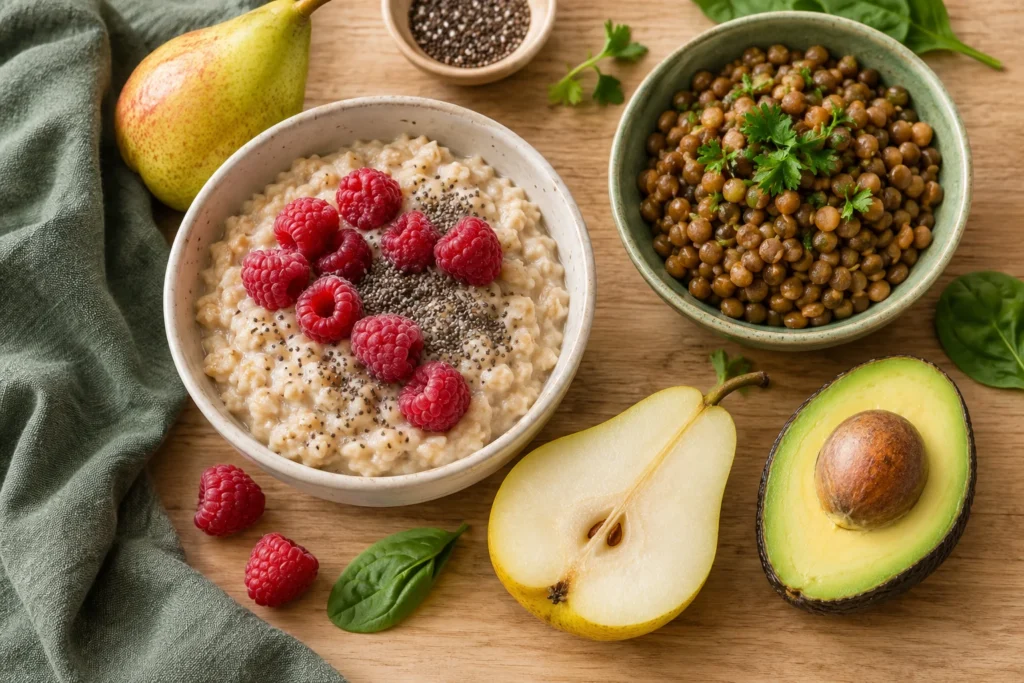
- Lentils or black beans, 1 cup cooked: about 15 grams
- Chia seeds, 2 tablespoons: about 10 grams
- Raspberries, 1 cup: about 8 grams
- Pear with skin, 1 medium: about 6 grams
- Avocado, half: about 5 grams
- Oatmeal, 1 cup cooked: about 4 grams
One cup of beans and one cup of raspberries cover almost all of a day’s target. Build each meal around one high-fiber food and the total takes care of itself.
How to Add Fiber Without Bloating
Going from 12 grams to 25 overnight is the most common mistake. Your gut needs time to adjust. Raise your daily total by about 5 grams each week, and drink an extra glass or two of water as you go.
If food alone still leaves you short, a fiber powder is a simple way to close the gap. Stir it into water or a smoothie, start with half a serving and build up.
When to Check With Your Doctor
See your doctor if constipation, bloating or stomach pain is new, severe or lasts more than a couple of weeks. Check first before adding a fiber supplement if you have a digestive condition or take medication, since fiber can slow how some medicines are absorbed.
This article is for general education and is not medical advice. Statements about dietary supplements have not been evaluated by the Food and Drug Administration, and supplements are not intended to diagnose, treat, cure or prevent any disease.
Check with your doctor or pharmacist before taking a new supplement, especially if you are pregnant or nursing, take medication, or have a health condition. Vital Luke links to reviews on coachluke.com, where Coach Luke may earn a commission if you buy.